Artificial Intelligence Explained: Definition, Uses, and Types You Should Know
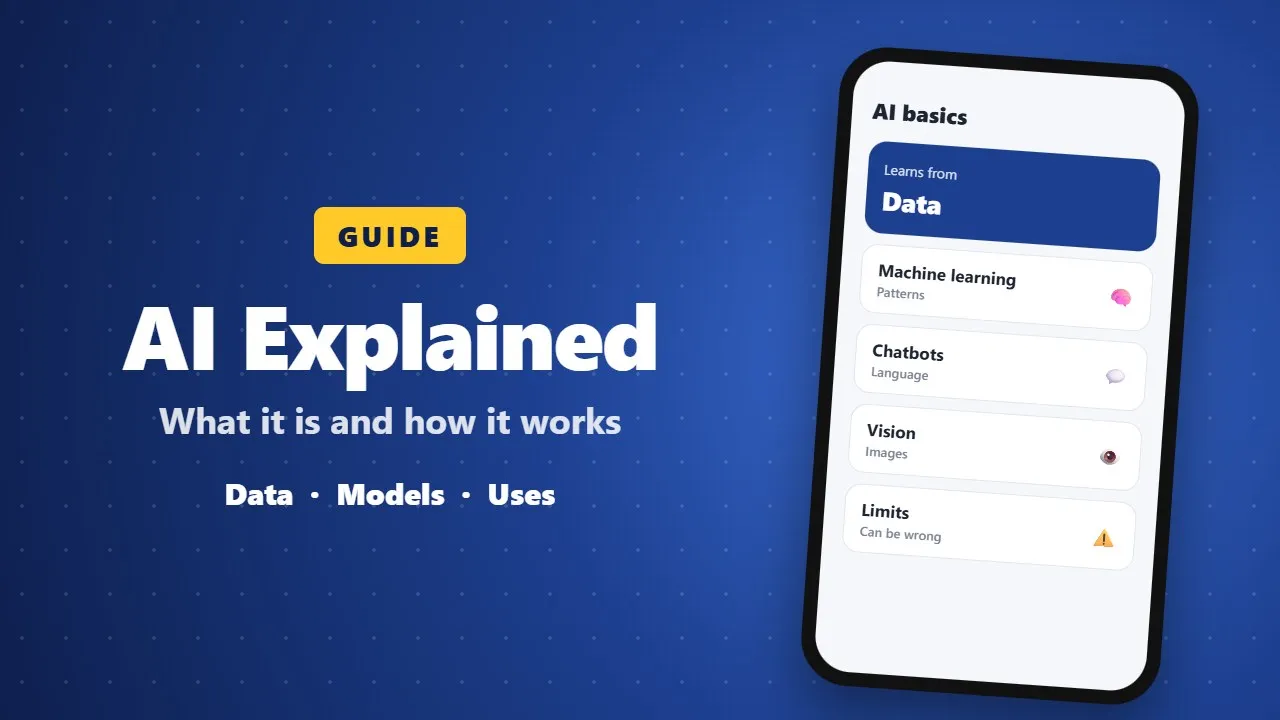
A plain-language guide to artificial intelligence: what it is, how it learns from data, the main types of AI, and where you already meet it in daily life, from phone assistants to translation apps.
Artificial Intelligence (AI) is one of the most transformative technologies of our time, reshaping industries, communication, and everyday life. It has become a driving force behind automation, innovation, and smarter decision-making. But what exactly is AI, how is it used, and what are its main types? Let’s explore these questions in detail.
Definition of Artificial Intelligence
Artificial Intelligence refers to the simulation of human intelligence by machines—especially computer systems—that are programmed to think, learn, and solve problems like humans. In simple terms, AI enables computers to perform tasks that typically require human intelligence, such as recognizing speech, making decisions, understanding languages, and identifying patterns.
AI systems use large amounts of data combined with algorithms to learn from experience. This process, known as machine learning, allows systems to improve their performance over time without being explicitly programmed for every task.
How AI Works
AI operates through the combination of data, algorithms, and computing power. The system analyzes massive datasets, identifies patterns, and uses those patterns to make predictions or decisions. For example, when you use Google Maps, AI analyzes traffic data to find the fastest route. Similarly, when Netflix recommends movies, it’s using AI to predict what you’ll enjoy based on your viewing history.
Uses of Artificial Intelligence
AI is now integrated into nearly every aspect of modern technology. Here are some of the most common uses:
-
Healthcare
AI assists doctors in diagnosing diseases, analyzing medical images, and predicting patient outcomes. Tools like IBM Watson Health help identify treatment options faster and more accurately. -
Business and Finance
Companies use AI for data analysis, customer service chatbots, fraud detection, and predictive analytics. In finance, AI helps assess risks, detect suspicious transactions, and even provide investment advice. -
Transportation
Self-driving cars, traffic management systems, and delivery drones all rely on AI. These systems process real-time data to make safe and efficient driving decisions. -
Education
AI-powered tools personalize learning experiences. Platforms like Duolingo and Coursera use AI to adapt lessons based on each learner’s progress. -
Entertainment and Social Media
Streaming services, recommendation systems, and photo filters all use AI to enhance user experiences. Social media platforms also use AI to detect harmful content and improve user engagement. -
Daily Life
Voice assistants such as Siri, Alexa, and Google Assistant are examples of AI in everyday life. They understand speech, answer questions, and automate simple tasks.
Types of Artificial Intelligence
AI can be classified into three main types based on its capability:
-
Narrow AI (Weak AI)
This type of AI is designed to perform a specific task. Examples include virtual assistants, spam filters, and recommendation systems. Most current AI applications fall into this category. -
General AI (Strong AI)
General AI refers to a system with human-like cognitive abilities—able to reason, learn, and solve any problem. This type of AI is still theoretical and under research. -
Super AI
Super AI would surpass human intelligence and capabilities, making independent decisions beyond human understanding. It’s still a futuristic concept, but one that sparks debate about ethics and control.
Conclusion
Artificial Intelligence is revolutionizing how we live and work. From simplifying daily tasks to transforming global industries, AI continues to evolve rapidly. Understanding its definition, uses, and types helps us appreciate both its benefits and challenges. As technology advances, responsible AI development will be key to ensuring it remains a force for good in the world.