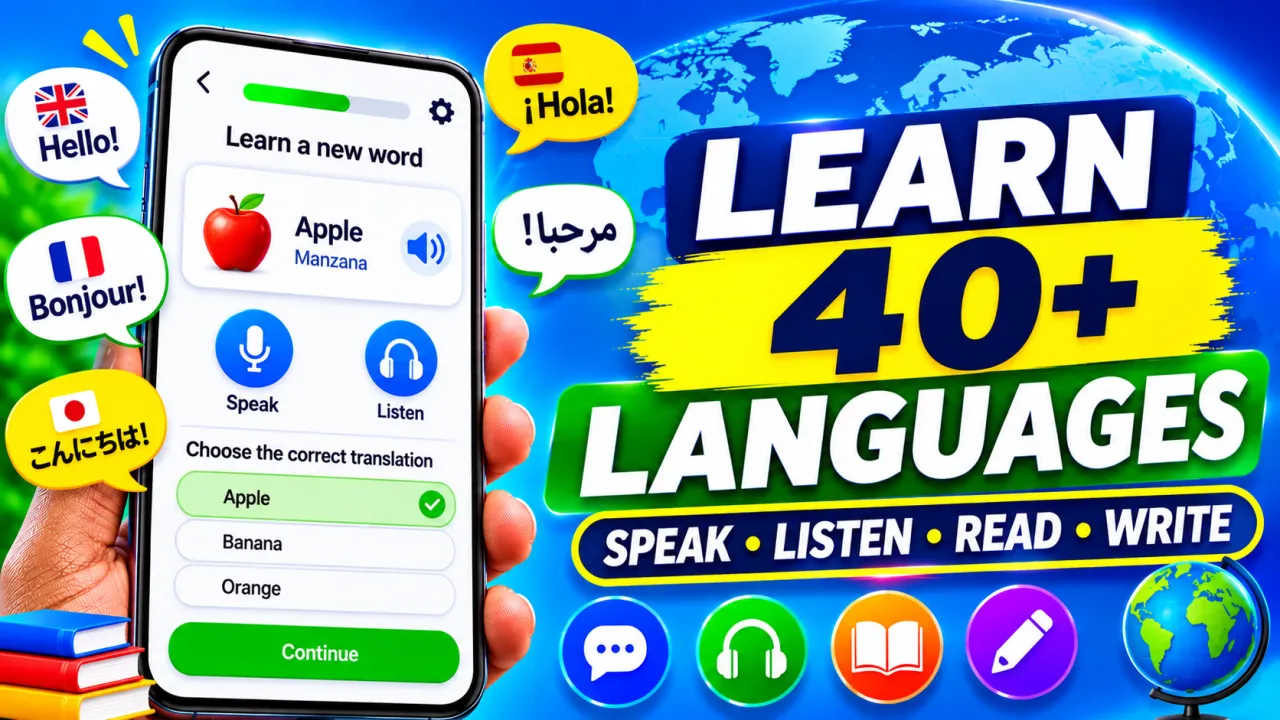
Learn English and 40+ Languages: 7 Ways Duolingo Makes Learning Fun
Want to learn English or another language using your smartphone? Discover how Duolingo helps you practice speaking, reading, listening, and writing through short interactive lessons, daily challenges, and fun learning activities.
Learn English and 40+ Languages: 7 Ways Duolingo Makes Learning Fun
Do you want to improve your English, learn a new language, or develop useful skills directly from your smartphone? Learning a language does not always require attending a classroom or buying expensive textbooks. With the right learning application, you can practice wherever you are.
Duolingo is a popular educational application that helps users learn more than 40 languages through short, interactive lessons. It offers exercises for speaking, reading, listening, and writing, making language practice more engaging.
The application also includes learning activities for mathematics, music, and chess.
Let's explore seven useful features that make Duolingo worth trying.
1. Learn English and Other Languages
One of Duolingo's main features is its language-learning courses.
You can explore languages such as English, Spanish, French, German, Italian, Portuguese, Japanese, Korean, Arabic, and many others.
Whether you are a beginner or want to improve your existing language skills, the lessons provide opportunities to practice vocabulary, grammar, and everyday expressions.
This can be particularly useful for students, travelers, and people preparing for international opportunities.
2. Practice Speaking and Listening
Learning a language involves more than memorizing words.
Duolingo includes speaking and listening exercises that help you become familiar with pronunciation and spoken conversations.
Some lessons ask you to listen to a sentence and choose the correct answer, while others allow you to speak into your phone's microphone.
These activities can help you become more comfortable recognizing and producing words in your target language.
3. Improve Your Reading and Writing Skills
Reading and writing are important parts of language learning.
Duolingo provides exercises that ask you to translate sentences, complete missing words, arrange words in the correct order, and understand short passages.
These activities help you practice vocabulary and sentence structure.
Regular practice can gradually improve your ability to understand written content and express your ideas.
4. Learn Through Short Interactive Lessons
One interesting feature is its bite-sized lesson format.
Instead of studying for several hours at once, you can complete short exercises during breaks or free time.
The lessons include different question types, interactive activities, and progress rewards.
This approach can make learning easier to fit into a busy daily schedule.
You can choose a learning goal and work toward completing regular lessons.
5. Build a Daily Learning Habit
Consistency is important when learning a new language.
Duolingo uses streaks, achievements, rewards, and leaderboards to encourage users to practice regularly.
Your learning streak can help motivate you to return to your lessons every day.
You can also track your progress and see how your learning activities develop over time.
Remember that maintaining a streak is not the same as mastering a language. Focus on understanding and practicing what you learn.
6. Explore Mathematics, Music, and Chess
Duolingo is not limited to language learning.
The application also offers additional educational courses.
Mathematics: Practice multiplication, fractions, geometry, and other mathematical concepts through interactive exercises.
Music: Learn musical concepts and practice using an on-screen keyboard without needing a physical instrument.
Chess: Explore chess basics, solve puzzles, practice strategies, and play online matches.
These additional activities make the application useful for people interested in developing different skills.
Availability of courses may depend on your language, device, and region.
7. Learn with AI-Powered Features
Duolingo also offers advanced AI-powered learning features through Duolingo Max in supported courses and regions.
Features such as Video Call and Roleplay can provide opportunities to practice conversations and receive feedback.
These tools are designed to make language practice more interactive by allowing learners to explore conversational situations.
However, advanced features may require a paid subscription and may not be available to every user.
How to Get Started with Duolingo
Getting started is simple:
- Open the Google Play Store.
- Search for Duolingo: Language Lessons.
- Install and open the application.
- Select the language you want to learn.
- Choose your learning level or follow the placement process.
- Set a daily learning goal.
- Start completing interactive lessons.
- Review your progress and practice regularly.
You can begin with the free learning experience. The application contains advertisements and offers optional in-app purchases and subscriptions for additional features.
Tips to Improve Your Learning Experience
To get more from Duolingo, try these simple tips:
- Practice every day, even if you only have a few minutes.
- Repeat lessons when you find a topic difficult.
- Write down new vocabulary.
- Practice speaking the words you learn.
- Listen carefully to pronunciation exercises.
- Use newly learned words in real conversations.
Remember that a language-learning application is a helpful practice tool, but combining it with reading, listening, and real conversations can improve your overall learning experience.
Conclusion
Duolingo makes learning more accessible through short interactive lessons, progress tracking, speaking exercises, listening practice, and additional educational activities.
Whether you want to improve your English, learn Spanish, explore another language, or practice mathematics and chess, the application offers several learning opportunities in one place.
If you want to make better use of your free time and develop new skills, Duolingo is worth exploring.